
Experimental and Observation Facilities
Last Update: Feb. 1st, 2019
Basic Hydraulic Experimental Facilities
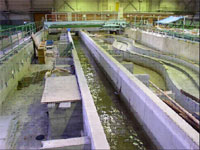
- 2-Dimensional Flow Channel
There are channels of various sizes with various accessories, which are needed for proposing and revising hydraulic design methods of river structures, studying habitats of river organisms, etc.
- 2-Dimensional Flow Channel
- Sediment Transport Channel
- Inclination-variable Sediment Cycle Channel
- Structure Channel
- Meandering Channel
Large Scale Experimental Channel
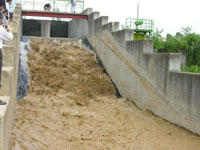
- High Drop Channel
Studies that need full-scale experiments are conducted using the following three large channel models, which are largest in Japan.
- High-speed Flow Channel
Mainly researching soil erosion of embankment surfaces - High Drop Channel
Building a full-sized embankment model and investigating on
overflow, seepage, and piping - Large Scale Channel
Discharging a large amount of earth, sand, and water to observe development of sand bars
and influence of plants on flow velocity
Outdoor Model Experiment Facilities
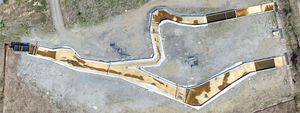
- Gokase River Model
Reduced sized models of sections of rivers are constructed to experimentally investigate channel designs and problems related to the designs of river structures, such as weirs and revetment. Reduced sized models of sections of rivers are constructed to experimentally investigate channel designs and problems related to the designs of river structures, such as weirs and revetment.
-
The main models in 2018
- Yahagi River Model
- Ohkouzu Diversion Channel Model
- Katsura River Model
- Sendai River Model
Indoor Model Experimental Facilities (Under Renovation)
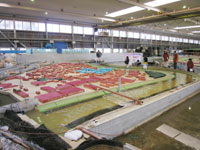
- Kariyata River Model
Small ripples produced by wind on the surface of a model are huge waves of several meters when converted into an actual size, and thus phenomena shown in a model may differ from those in actual rivers. The facilities are covered with a 50m wide and 200m long roof to minimize the effects of wind. It is used for model experiments that need particularly precise water level measurements and for studying diverging points and river mouths. It is being renovated to create new models and undertake a case study of July 2017 Heavy Rain in Northern Kyushu.
Water Quality Analytical Lab.
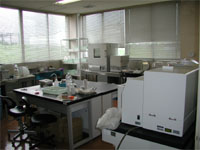
- Water Quality Analytical Lab.
Rivers transport sediments, nutrients and toxic substances from land and flood plains together with water collected from the basin. The water quality analytical laboratory is equipped with various kinds of analytical instruments and refrigerators and analyzes substances contained in turbid water collected from several target rivers in Japan during floods.
Hinuma River Flood Observatory (Removed in 2018)
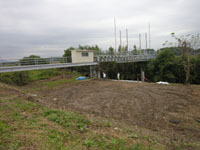
- Hinuma River Flood Observatory
The observatory was located at 28.1 km point on the Hinuma River of the Naka River System. It consisted of a 30m span support constructed across the low-flow channel, a 15m span elevating stage on the support, and an inspection bridge. The elevating stage was on the low-flow channel and moved vertically within a range of 6 m to facilitate flowing water to be observed from a short distance even during a flood. The observatory terminated its operation and removed in 2018.
To the top of this page